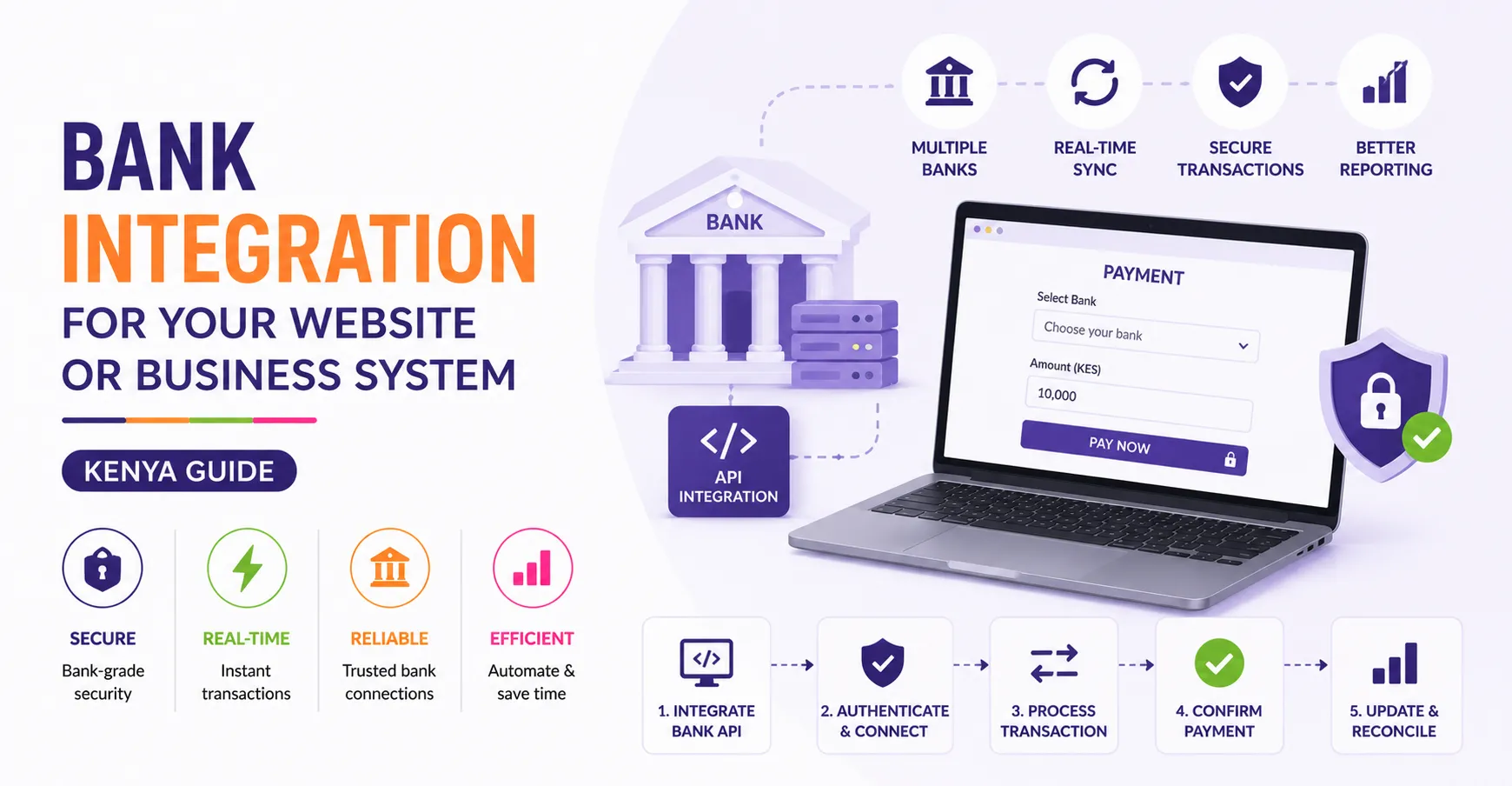
How to Do Bank Integration for Your Website or Business System (Kenya Guide)
Learn how bank integration works in Kenya — payment aggregators, Jenga API, PesaLink, bulk disbursements, and reconciliation — explained step by step.
How to Do Bank Integration for Your Website or Business System (A Detailed Guide)
While M-Pesa dominates retail payments in Kenya, bank integration matters for a different set of needs: card payments, bulk disbursements (like payroll or supplier payments), corporate account reconciliation, and serving customers who prefer paying directly from their bank account. Here's how bank integration actually works and how to approach it.
Why Bank Integration Is Different From M-Pesa
Bank integration in Kenya typically falls into a few categories.
Card payment processing (Visa/Mastercard) via a payment gateway.
Direct bank API integration for corporate accounts, such as Equity's Jenga API, KCB's API, or Co-op Bank's API.
Bulk payments and disbursements — paying multiple suppliers, employees, or agents from one instruction.
Bank statement reconciliation — automatically pulling and matching transactions against your accounting records.
Unlike M-Pesa's single dominant gateway (Daraja), each bank has its own API, documentation, and onboarding process — so the right approach depends on which bank or banks you and your customers use most.
Option 1: Use a Payment Aggregator (Fastest Route)
If you need to accept card and bank payments without building integrations for every individual bank, a payment aggregator is usually the practical starting point. Providers like Pesapal, Flutterwave, DPO (Direct Pay Online), or IntaSend let you integrate once and accept payments across multiple banks and cards through a single API.
General flow:
Register a merchant account with the aggregator and complete KYC verification.
Get your API keys for sandbox and live environments.
Integrate their checkout SDK or API on your site — usually a redirect or embedded widget.
Handle the payment callback or webhook to confirm success and update your order status.
Funds settle to your bank account on the aggregator's payout schedule, often T+1 or T+2 business days.
This is the fastest way to accept Visa, Mastercard, and multiple bank transfers without negotiating with each bank individually.
Option 2: Direct Bank API Integration (For Corporate/Enterprise Needs)
If you're a larger business needing direct integration — for example, automatically pulling your account statement into your accounting system, or making bulk payments to hundreds of suppliers — you'll work directly with a bank's API.
Example: Equity Bank's Jenga API
Jenga API offers services including the following.
Account balance and mini-statement queries.
Fund transfers (internal, RTGS, EFT, PesaLink).
Bill payments.
Airtime purchase.
Typical integration steps:
Register as a developer on the bank's developer portal and request API access.
Complete the bank's onboarding and compliance requirements (this can include signing agreements and providing business documentation).
Receive sandbox credentials (API key, merchant code, consumer secret) to test against.
Authenticate requests — most bank APIs use OAuth2 or signed token-based authentication similar to Daraja.
Test each required function (balance query, transfer, statement pull) thoroughly in sandbox.
Apply for production credentials and go live, usually after a review process.
Example: PesaLink for Interbank Transfers
PesaLink, run by the Integrated Payment Services Limited (IPSL) consortium of Kenyan banks, allows near-instant transfers between different banks using just a phone number or account number. It's commonly used for building payout/disbursement features without needing separate integrations for every bank your recipients use.
Option 3: Bulk Disbursement Integration
If your business needs to pay many recipients at once (payroll, supplier payments, agent commissions), most banks and aggregators offer a bulk payment API where you submit a batch file or API call listing the recipient account or phone number, the amount, and a reference or narration.
The system processes payments in bulk and returns a status report for each transaction — useful for automating payroll runs or supplier settlements instead of doing manual bank transfers one by one.
Option 4: Bank Statement Reconciliation Integration
For businesses that want their accounting or ERP system to automatically reflect real bank activity, some banks provide statement/transaction feed APIs, or you can use aggregator webhooks that fire on every incoming payment. This eliminates manual downloading and re-entry of bank statements into your books each month, and it flags mismatches (like an invoice that hasn't been paid, or a payment with no matching invoice) automatically.
Key Technical and Compliance Considerations
Authentication: Most Kenyan bank APIs use OAuth2 or HMAC-signed requests — never hardcode secrets in frontend code.
IP whitelisting: Some banks require you to whitelist your server's IP address before granting API access.
Compliance documentation: Expect to provide business registration, KRA PIN, and sometimes a signed API agreement before going live.
Sandbox-first testing: Every bank API has a sandbox environment — never attempt to build directly against production.
Webhook reliability: Design your system to handle retried or delayed webhook callbacks without creating duplicate transactions.
Reconciliation logic: Build clear rules for matching incoming payments to invoices, especially when payment references don't match exactly.
Choosing Between M-Pesa, Aggregators, and Direct Bank APIs
Retail customers paying small amounts: M-Pesa (Daraja STK Push).
Accepting card payments (Visa/Mastercard): Payment aggregator (Pesapal, Flutterwave, DPO, IntaSend).
Corporate account management, large transfers: Direct bank API (Equity Jenga, KCB, Co-op).
Paying many suppliers/employees at once: Bulk disbursement API or PesaLink.
Automated bookkeeping and reconciliation: Bank statement/transaction feed integration.
Most growing businesses eventually use a combination — M-Pesa for retail checkout, an aggregator for card payments, and direct bank integration for treasury and payroll functions.
Final Thoughts
Bank integration is more fragmented than M-Pesa integration simply because there's no single dominant gateway — but the payoff is real: faster reconciliation, fewer manual errors, and the ability to serve customers and partners who prefer paying through their bank rather than mobile money.
At Timesten Technologies, we handle payment gateway integrations — M-Pesa, card processing, and direct bank APIs — as part of our custom web development and ERP consulting services. If you're trying to figure out which integration path makes sense for your business, we're happy to map it out with you.
Get in touch: timestentechnologies.co.ke | WhatsApp: 0795 155 230
Other Blogs
Contact Us
Ready to take your business to the next level? Reach out to Timesten Technologies today. Whether you have a question, need more information about our services, or are ready to start a project, we're here to help. Connect with us, and let's discuss how we can work together to achieve your goals. Your success is just a message away!
our partners