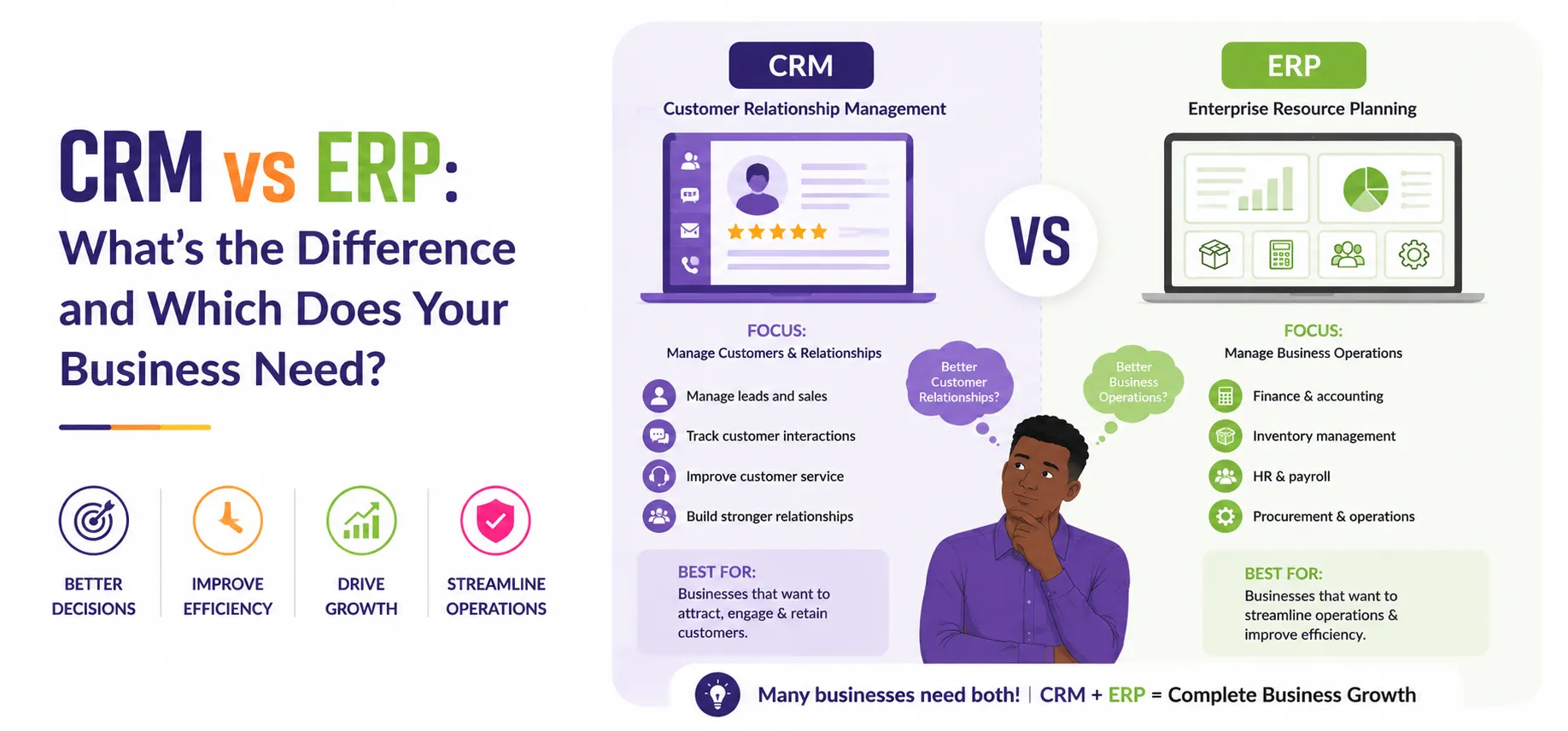
CRM vs ERP: What's the Difference and Which Does Your Business Need?
CRM vs ERP: What's the Difference and Which Does Your Business Need? Meta Description: Confused between CRM and ERP? Learn the real difference, see a practical Kenyan business example, and find out which system fits your needs first.
CRM vs ERP: What's the Difference and Which Does Your Business Need?
If you've started shopping for business software, you've likely run into both terms — CRM and ERP — often used as if they're interchangeable. They're not, and understanding the difference will save you from buying the wrong system, or worse, paying for one that doesn't solve your actual problem.
What Is a CRM?
CRM stands for Customer Relationship Management. It's built around one core job: managing everything related to your interactions with customers and prospects. A good CRM tracks leads and enquiries from first contact to closed sale, follow-up reminders and communication history, sales pipeline stages (new lead, contacted, proposal, won or lost), customer complaints and support tickets, and marketing campaign performance.
If your biggest challenge is "we keep losing track of leads" or "our sales team forgets to follow up," a CRM is what you need.
What Is an ERP?
ERP stands for Enterprise Resource Planning. It's a much broader system designed to run your entire business operation, connecting departments that would otherwise work in silos: inventory and stock management, accounting and financial reporting, payroll and HR, procurement and supplier management, and order and production management. Often, a CRM module is included as one piece of the larger system.
If your challenge is "our departments don't share information" or "we can't get an accurate picture of stock, sales, and finances in one place," you need an ERP.
The Key Difference in One Sentence
A CRM manages your relationship with customers. An ERP manages the operations of your entire business — of which customer relationships are just one part.
A Practical Example
Imagine a Nairobi-based furniture retailer. Their sales team uses a CRM to track which customers enquired about a sofa set, when to follow up, and who's ready to buy. Once a sale closes, an ERP takes over — it deducts the sofa from stock, generates a KRA-compliant invoice, records the M-Pesa payment, and updates the accounting ledger — all automatically.
Many businesses eventually need both, which is why most modern ERP systems (like Odoo) include a CRM module baked in, so you're not managing two disconnected systems.
Which One Does Your Business Need First?
Choose a CRM first if you're primarily sales and service-driven with a relatively simple back office, your biggest pain is lead follow-up rather than stock or accounting, or you're a small team (agency, consultancy, real estate brokerage) focused on relationship-building.
Choose an ERP first if you manage physical inventory, multiple branches, or complex financial operations, you need payroll, procurement, and accounting connected to sales data, or you're a retailer, wholesaler, school, property manager, or manufacturer.
Choose an integrated ERP+CRM if you want lead tracking and operational management to share the same data — so a closed deal automatically triggers invoicing, stock deduction, and delivery scheduling without manual re-entry.
Common Mistake to Avoid
A lot of Kenyan SMEs buy a CRM expecting it to also manage inventory and accounting, then get frustrated when it can't. Others buy a heavy, generic ERP for a two-person sales team that just needed simple lead tracking. Matching the tool to the actual bottleneck in your business — not the trend — saves money and avoids abandoned software six months in.
Final Thoughts
CRM and ERP solve different problems, but they don't have to live in separate systems. The most efficient setup is one platform where your customer relationships and your business operations share the same data — so nothing gets duplicated, lost, or forgotten between departments.
At Timesten Technologies, we help Kenyan businesses figure out exactly what they need — whether that's a focused CRM, a full ERP, or an integrated system like SuperShop or a customized Odoo deployment — and build it around your real workflow.
Get in touch: timestentechnologies.co.ke | WhatsApp: 0795 155 230
Other Blogs
Contact Us
Ready to take your business to the next level? Reach out to Timesten Technologies today. Whether you have a question, need more information about our services, or are ready to start a project, we're here to help. Connect with us, and let's discuss how we can work together to achieve your goals. Your success is just a message away!
our partners